
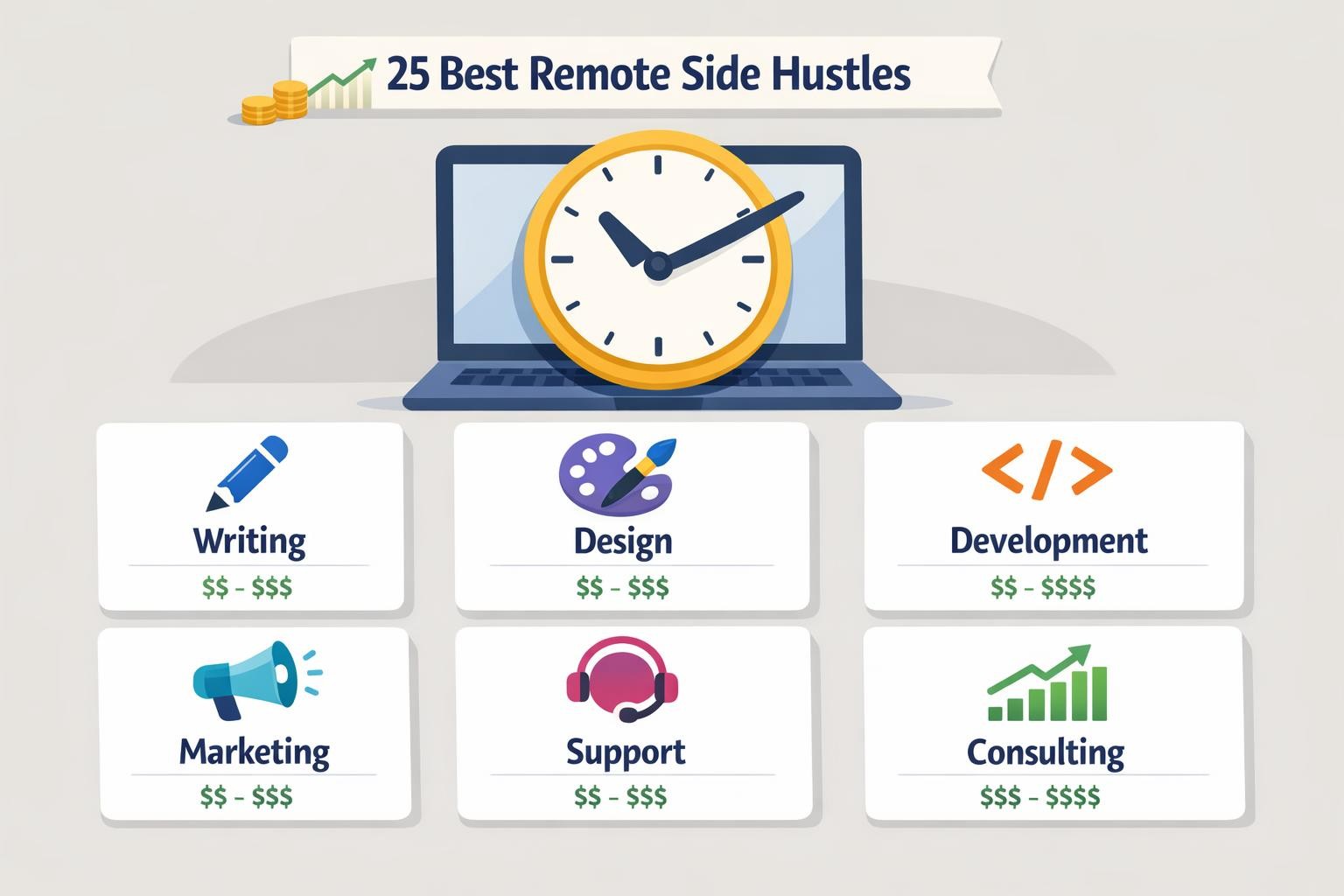
The average side hustler brings in $900 to $1,100 per month working 11 to 16 hours a week, according to recent workforce surveys. That is not quit-your-job money. But it is pay-off-debt money, build-an-emergency-fund money, and test-a-business-idea-without-risk money. The best remote side hustles in 2026 share three traits: they can be done from anywhere, they start generating income within weeks (not months), and they scale with your skills.
The gig economy market is projected to reach $674 billion in 2026, growing at a 15.79% annual rate. Over 76 million Americans now freelance, representing roughly 36% of the workforce. Whether you want to earn an extra $500 a month or build something that eventually replaces your salary, this list covers 25 remote side hustles organized by category with realistic income ranges, startup costs, and the fastest path to your first dollar.
One rule before we start: pick one. The biggest mistake new side hustlers make is starting three things at once and doing none of them well. Choose the one that matches your skills, commit to it for 90 days, then evaluate. If you are weighing freelance versus full-time remote work, starting with a side hustle is the safest way to test the freelance waters.
Writing and Content Remote Side Hustles
1. Freelance Blog Writing
- Income range: $500-$4,000/month
- Time commitment: 5-15 hours/week
- Startup cost: $0
- Difficulty: Beginner-friendly
Businesses need blog content for SEO, and most do not have in-house writers to produce it. If you can research a topic, organize information clearly, and write in a conversational tone, you can freelance as a blog writer. Rates range from $0.08 to $0.30 per word for general content, with specialized niches (finance, health, SaaS) paying $0.20 to $0.50+ per word.
First client path: Create three sample posts on a topic you know well. Pitch five businesses in that niche via email with a link to your samples and a specific idea for a post they should publish. When Marcus pivoted from teaching to freelance writing, he landed his first $200 article by cold-emailing a SaaS startup with a draft outline they had not thought of.
2. Copywriting
- Income range: $1,000-$6,000/month
- Time commitment: 5-15 hours/week
- Startup cost: $0
- Difficulty: Intermediate
Copywriting is writing that sells: landing pages, email sequences, ads, product descriptions. It pays more than blog writing because it is directly tied to revenue. A single sales page can earn $500-$2,000. Email sequences pay $50-$150 per email.
First client path: Rewrite a company's existing landing page or email as a free sample. Send it to them with a short note explaining what you changed and why. This demonstrates your value without requiring them to take a risk.
3. Resume and LinkedIn Writing
- Income range: $500-$3,000/month
- Time commitment: 5-10 hours/week
- Startup cost: $0
- Difficulty: Beginner-friendly
Millions of people need help with their resumes and LinkedIn profiles but do not know how to write them. If you understand what hiring managers look for (clear formatting, quantified achievements, keyword optimization), you can charge $100-$400 per resume and $50-$200 per LinkedIn profile.
First client path: Offer to rewrite five friends' resumes for free, collect testimonials, and post your service on LinkedIn with before/after examples.
4. Technical Writing
- Income range: $1,500-$5,000/month
- Time commitment: 8-15 hours/week
- Startup cost: $0
- Difficulty: Intermediate
If you can explain technical concepts in plain language, companies will pay you well for it. Technical writers create documentation, API guides, tutorials, and knowledge base articles. Rates start at $40/hour and climb to $100+ for specialized domains like cybersecurity, cloud infrastructure, or developer tools.
First client path: Contribute to open-source documentation on GitHub. This builds a portfolio and puts you in direct contact with companies that need technical writers.
Design and Creative Side Hustles
5. Graphic Design
- Income range: $500-$4,000/month
- Time commitment: 5-15 hours/week
- Startup cost: $0-50 (Canva Pro or Figma)
- Difficulty: Beginner to intermediate
Small businesses need social media graphics, pitch decks, flyers, and brand assets but cannot afford a full-time designer. If you can use Canva, Figma, or Adobe tools, you can sell design work. Rates range from $25 to $75/hour depending on complexity and client size.
First client path: Redesign a local business's social media posts and send them a comparison. "Here is your current Instagram, and here is what it could look like." Visual proof converts faster than any pitch.
6. Video Editing
- Income range: $1,000-$5,000/month
- Time commitment: 8-15 hours/week
- Startup cost: $0-30 (DaVinci Resolve is free)
- Difficulty: Intermediate
YouTube creators, podcasters, and businesses need editors. The demand for short-form clips (YouTube Shorts, TikTok, Instagram Reels) has created a massive market for editors who can turn long content into punchy 60-second clips. Rates run $20-$75 per video for short-form and $100-$500 for long-form edits.
First client path: Download a public YouTube video, re-edit it as a sample, and pitch the creator with your version. Include timestamps showing what you cut, what you added, and why.
7. UGC (User-Generated Content) Creation
- Income range: $500-$3,000/month
- Time commitment: 5-10 hours/week
- Startup cost: $0 (just your phone)
- Difficulty: Beginner-friendly
Brands pay regular people to create authentic-looking product videos for ads and social media. You do not need a following. You just need a decent phone camera and the ability to speak naturally about a product. Rates range from $50-$300 per video.
First client path: Film three sample UGC videos with products you already own. Post them on a UGC portfolio page and pitch brands on Instagram or through UGC platforms like Billo or JoinBrands.
Tech and Development Remote Side Hustles
8. Web Development
- Income range: $1,500-$8,000/month
- Time commitment: 10-20 hours/week
- Startup cost: $0
- Difficulty: Intermediate to advanced
Building and maintaining websites is one of the highest-paying side hustles available. Simple WordPress sites pay $500-$2,000. Custom web applications pay $3,000-$10,000+. Ongoing maintenance retainers ($200-$500/month per client) create predictable recurring income.
First client path: Build a portfolio site showcasing two or three sample projects. List yourself on Upwork and Toptal, and pitch local businesses whose websites need updating. Browse remote software development jobs for contract opportunities that work alongside a day job.
9. AI Automation Consulting
- Income range: $1,000-$8,000/month
- Time commitment: 5-15 hours/week
- Startup cost: $0-50
- Difficulty: Intermediate
Companies are drowning in AI tools they do not know how to use. If you can build workflows in Zapier, Make, or n8n that connect AI tools to existing business processes, you can charge $100-$250/hour for consulting. Common projects include setting up AI-powered customer support chatbots, automating data entry workflows, and building content pipelines. For more on how AI is reshaping the job market, see our guide on AI tools for remote job searching.
First client path: Automate one process for a small business for free. Document the time saved, then use that case study to pitch similar businesses at full rate.
10. QA Testing
- Income range: $400-$2,000/month
- Time commitment: 5-12 hours/week
- Startup cost: $0
- Difficulty: Beginner-friendly
Companies pay testers to find bugs in websites and apps. Platforms like UserTesting, BugCrowd, and Testlio connect testers with companies. Pay ranges from $10-$60 per test for usability testing and higher for specialized bug bounty work. No coding required for basic testing roles.
First client path: Sign up on UserTesting and Testlio. Complete your profile tests (which also pay) and start accepting assignments. Consistency matters more than volume.
11. No-Code App Building
- Income range: $800-$5,000/month
- Time commitment: 8-15 hours/week
- Startup cost: $0-50
- Difficulty: Intermediate
Tools like Bubble, Glide, and Softr let you build functional web and mobile apps without writing code. Small businesses need simple apps: appointment booking systems, internal dashboards, client portals, inventory trackers. Charge $500-$3,000 per project.
First client path: Build a sample app that solves a common business problem (like a client booking tool), then show it to local businesses who are still using spreadsheets.
Consulting and Coaching
12. Freelance Marketing Consulting
- Income range: $1,000-$6,000/month
- Time commitment: 5-15 hours/week
- Startup cost: $0
- Difficulty: Intermediate
If you have marketing experience from a day job, you can consult for smaller companies that cannot afford a full marketing hire. Services include SEO audits, social media strategy, email marketing setup, and paid ads management. Rates start at $75/hour and go up with specialization. Explore remote marketing jobs for consulting-friendly contract roles.
First client path: Audit a business's marketing for free. Present three specific, actionable recommendations with estimated revenue impact. Offer to implement them for a monthly retainer.
13. Career Coaching
- Income range: $500-$4,000/month
- Time commitment: 5-10 hours/week
- Startup cost: $0
- Difficulty: Intermediate
If you have hired people, managed teams, or successfully changed careers, you have knowledge that others will pay for. Career coaches charge $75-$300 per session. Packages (four sessions plus resume review) sell for $500-$1,500.
First client path: Offer three free coaching sessions to build testimonials. Post results-oriented content on LinkedIn. "I helped a client land a remote product manager role in six weeks" converts better than "I offer career coaching."
14. Online Tutoring
- Income range: $500-$3,000/month
- Time commitment: 5-15 hours/week
- Startup cost: $0
- Difficulty: Beginner-friendly
If you are knowledgeable in a subject, from math and science to test prep and language learning, tutoring platforms connect you with students globally. Rates range from $15-$80/hour depending on the subject and your credentials. Higher-level subjects (college-level math, MCAT prep, coding) command the highest rates.
First client path: Sign up on Wyzant, Tutor.com, or Preply. Build a profile with your qualifications and set competitive introductory rates. Your first five positive reviews will generate organic referrals.
15. Bookkeeping
- Income range: $800-$3,000/month
- Time commitment: 5-15 hours/week
- Startup cost: $0-50 (QuickBooks Online)
- Difficulty: Beginner to intermediate
Small businesses need someone to manage their books, but most cannot justify a full-time bookkeeper. If you are comfortable with numbers and willing to learn QuickBooks or Xero, you can manage monthly bookkeeping for $200-$500 per client. Three to five clients and you have a solid side income.
First client path: Get QuickBooks certified (free through Intuit). Offer your first client a discounted first month. Small e-commerce businesses and freelancers are the easiest first clients because their books are relatively simple.
Teaching and Content
16. Online Course Creation
- Income range: $200-$5,000/month (passive after creation)
- Time commitment: 40-80 hours upfront, 2-5 hours/week ongoing
- Startup cost: $0-100
- Difficulty: Intermediate
If you have specialized knowledge in any field, you can package it into a course and sell it on Udemy, Skillshare, or Teachable. The upfront time investment is significant, but courses generate passive income for years. The average Udemy instructor with a well-marketed course earns $1,000-$3,000/month.
First client path: Teach the course content live first via a free workshop or webinar. Record the workshop, refine it into modules, and publish on a course platform. Live teaching validates demand before you invest in production.
17. Podcast Editing and Production
- Income range: $500-$3,000/month
- Time commitment: 5-12 hours/week
- Startup cost: $0 (Audacity is free)
- Difficulty: Beginner to intermediate
There are over 4 million podcasts, and most creators hate editing. Basic podcast editing (removing ums, balancing audio, adding intros/outros) pays $50-$150 per episode. Full production services (show notes, social clips, scheduling) pay $200-$500 per episode.
First client path: Edit a free sample episode for a small podcaster. Deliver it fast with a clear before/after audio comparison. Podcasters who hate editing will gladly pay to never do it again.
18. Newsletter Writing
- Income range: $300-$5,000/month
- Time commitment: 3-8 hours/week
- Startup cost: $0 (Substack or Beehiiv are free)
- Difficulty: Beginner to intermediate
Curated newsletters on niche topics build audiences that monetize through sponsorships, paid subscriptions, or affiliate links. A newsletter with 5,000 engaged subscribers can earn $500-$2,000/month from sponsorships alone. Niche topics (remote work, AI tools, specific industries) build audiences faster than general content.
First client path: Pick a narrow topic you can write about weekly. Publish consistently for 12 weeks. Promote each issue on social media. Growth is slow initially but compounds; most successful newsletters hit their stride around issue 30.
Administrative and Support
19. Virtual Assistant
- Income range: $500-$3,000/month
- Time commitment: 5-20 hours/week
- Startup cost: $0
- Difficulty: Beginner-friendly
Virtual assistants handle email management, scheduling, travel booking, data entry, and research. General VAs earn $15-$30/hour. Specialized VAs (executive assistants, real estate VAs, e-commerce VAs) earn $25-$50/hour. The barrier to entry is low, and the demand is consistently high. Browse remote freelance jobs for current VA openings.
First client path: List your services on Belay, Time Etc, or Fiverr. Start with a lower rate to build reviews, then raise your price after five positive reviews.
20. Social Media Management
- Income range: $500-$3,000/month
- Time commitment: 5-12 hours/week per client
- Startup cost: $0-30
- Difficulty: Beginner to intermediate
Small businesses know they need a social media presence but do not have time to maintain it. If you can create content calendars, write captions, schedule posts, and respond to comments, you can manage social accounts for $300-$800/month per client. Two or three clients and you have a meaningful side income.
First client path: Manage a friend's or local business's account for free for 30 days. Document the growth in followers, engagement, and reach. Use those metrics to pitch paying clients.
21. Customer Support Contractor
- Income range: $500-$2,500/month
- Time commitment: 10-20 hours/week
- Startup cost: $0
- Difficulty: Beginner-friendly
Startups and e-commerce brands often hire part-time remote customer support agents, especially during peak seasons. Pay ranges from $15-$25/hour. If you are patient, clear in your writing, and good at solving problems, this is one of the easiest side hustles to start. Browse remote contract jobs for current openings.
First client path: Apply directly to startups via their careers pages or through platforms like Hubstaff Talent and SupportDriven.
Digital Products and Passive Income
22. Selling Digital Templates
- Income range: $200-$3,000/month (passive)
- Time commitment: 20-40 hours upfront, 2-5 hours/week ongoing
- Startup cost: $0-50
- Difficulty: Beginner to intermediate
Notion templates, Canva templates, spreadsheet tools, and planning printables sell consistently on Etsy, Gumroad, and Creative Market. A single well-designed template can sell hundreds of copies at $5-$30 each. The work is front-loaded; once created, templates sell passively.
First client path: Identify a problem you solve with a spreadsheet or template in your own life. Package it, list it on Gumroad with a clear description and preview images, and promote it in relevant online communities.
23. Affiliate Marketing via Content
- Income range: $100-$3,000/month
- Time commitment: 5-10 hours/week
- Startup cost: $0-100 (domain and hosting)
- Difficulty: Intermediate
Writing product reviews, comparison articles, or how-to guides with affiliate links earns commission on every sale referred. Amazon Associates, ShareASale, and individual company affiliate programs pay 3-30% per sale. The key is building content around specific purchase decisions where people are actively looking for recommendations.
First client path: Start a simple blog or YouTube channel reviewing products in a niche you know. Focus on long-tail keywords ("best standing desk under $300") that attract buyers ready to purchase.
24. Stock Photography and Video
- Income range: $100-$1,500/month (passive)
- Time commitment: 5-10 hours/week
- Startup cost: $0 (phone camera works)
- Difficulty: Beginner-friendly
If you take decent photos or video, you can sell them on Shutterstock, Adobe Stock, and iStock. Individual sales are small ($0.25-$5 per download), but a library of 500+ images generates consistent passive income. Authentic lifestyle photos and business-context images sell better than generic stock.
First client path: Upload 50 images in a specific niche (remote work lifestyle, small business, food). Study what sells on each platform and produce more of what performs.
25. Print-on-Demand
- Income range: $100-$2,000/month
- Time commitment: 5-10 hours/week
- Startup cost: $0
- Difficulty: Beginner-friendly
Create designs for t-shirts, mugs, phone cases, and posters without holding inventory. Platforms like Redbubble, Merch by Amazon, and Printful handle printing and shipping. You earn $2-$10 per sale. Success depends on volume: the top sellers have hundreds of designs across multiple platforms.
First client path: Create 20-30 designs targeting a specific niche audience. List them across multiple platforms. Analyze which designs sell and create variations of your winners.
How to Get Your First Remote Side Hustle Client
Regardless of which side hustle you choose, landing your first paying client follows the same pattern.
- Build proof. Create two or three samples that demonstrate your skill. Do free work if necessary. The goal is evidence, not payment.
- Go where your clients are. If you are targeting small businesses, use LinkedIn. If you are targeting creators, use Twitter/X and Instagram. If you are targeting startups, browse job boards for contract roles.
- Pitch with value, not features. "I can increase your email open rates by 15%" works better than "I offer email marketing services." Be specific about the outcome you deliver.
- Start below market rate, then raise prices. Your first three clients are buying your potential, not your track record. Charge enough to be worth your time, but do not let pricing anxiety stop you from starting. After five successful projects, raise your rates 20-30%.
Watch out for scams when searching for freelance gigs. Our guide on how to spot remote job scams covers the red flags to watch for in client outreach and job listings.
Free resource: Download our Cold Email Templates -- use these to pitch clients for freelance and side hustle work.
The right remote side hustle for you depends on your existing skills, available time, and income goals. Start with one, give it a real 90-day effort, and adjust from there. For more guidance on balancing freelance work with full-time employment, read our guide on freelance vs. full-time remote work. And if you are ready to negotiate rates for your side hustle services, our salary negotiation guide covers the principles that apply to freelance pricing too.