
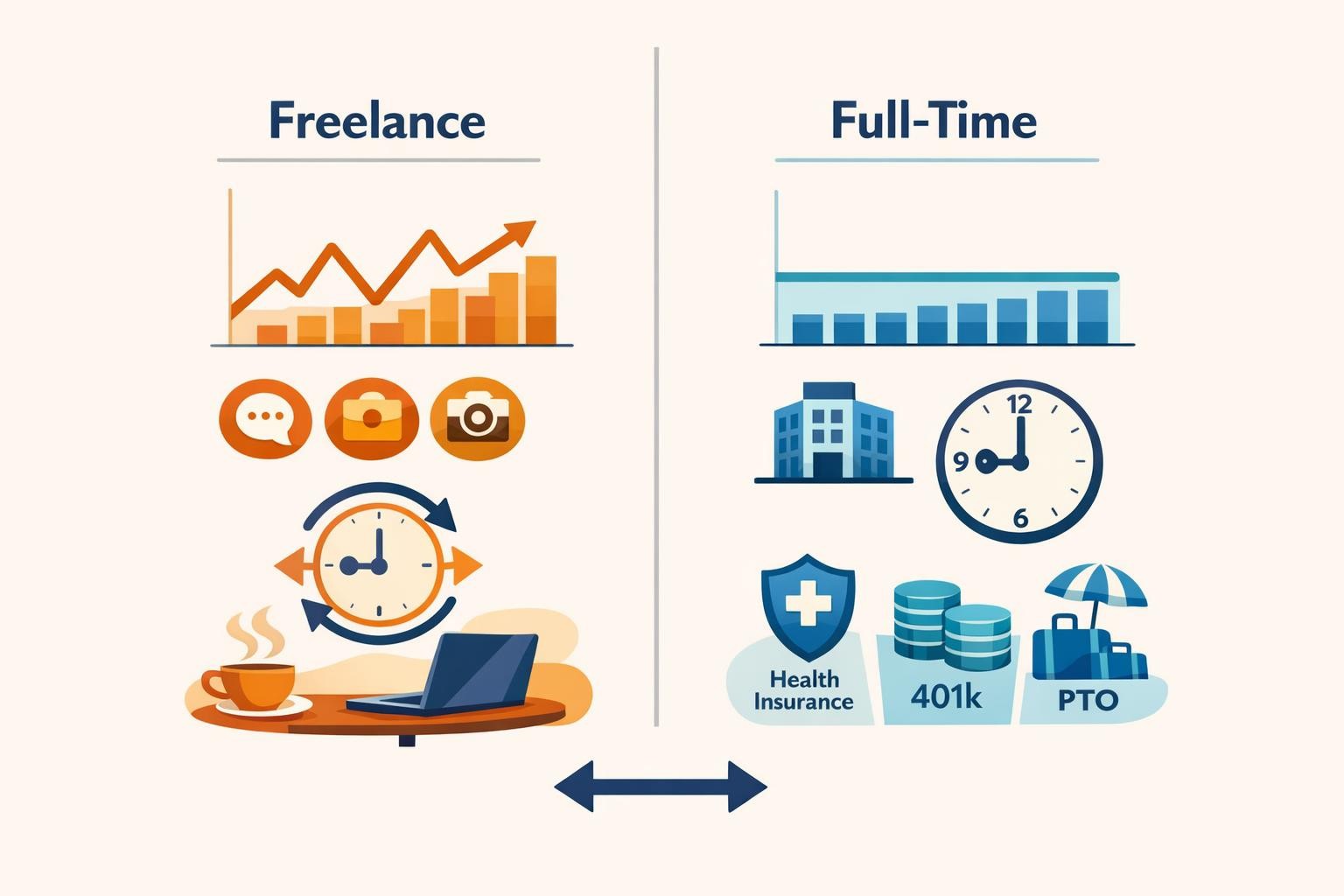
You already know you want to work remotely. The real question in the freelance vs full-time remote work debate is: employee or freelancer? Both give you location independence. Both can pay well. But they produce very different lives. Different income patterns, different tax bills, different daily rhythms, different career trajectories.
This guide compares them across the dimensions that actually affect your bank account, your schedule, and your career over the next one to five years. No lifestyle blog fantasies. Just the trade-offs, the math, and a decision framework at the end.
Income: Predictable Floor vs. Uncapped Ceiling
The Employee Paycheck
Full-time remote work means a number hits your bank account every two weeks. Same amount, same day, regardless of whether the company had a rough quarter.
- Budgeting is simple. Mortgage applications, car loans, financial planning: all straightforward when your income is fixed.
- Built-in raises. Most companies offer 3% to 5% annual increases, plus promotion bumps. A mid-level software engineer at Zapier earning $145,000 might be at $165,000 in two years without changing jobs.
- Downside protection. Even if the product tanks, you get paid until layoffs happen. That buffer matters.
The cost? A ceiling. Your income is capped by your role, level, and the company's pay bands. Earning significantly more means a promotion, a job change, or switching companies.
The Freelance Revenue Line
No floor. No ceiling. What you earn depends entirely on what you sell.
- Higher hourly rates. Freelance developers, designers, and copywriters typically charge 25% to 50% more per hour than equivalent full-time employees. A senior React developer earning $160,000 salary ($77/hour) might charge $120 to $150/hour as a freelancer. The premium exists because you are absorbing your own taxes, benefits, and business overhead.
- Feast-or-famine months. A strong month might bring $18,000. A dry month might bring $2,000. This volatility is the number one reason people quit freelancing.
- Scaling options. Unlike a salary, freelance income can jump quickly if you raise rates, specialize in a high-demand niche (say, AI integration consulting), or productize a service.
A 2026 Upwork report found the median knowledge-work freelancer earns $30/hour, but the top 25% earn over $78/hour. That is a 3x spread driven almost entirely by specialization and positioning.
Browse current opportunities on DailyRemote's freelance job listings and contract job listings to see what the market looks like in your field.
Benefits and Taxes: The Math Most People Skip
This is where freelance-vs-employee comparisons fall apart. People compare gross salary to gross freelance revenue and think they are doing apples to apples. They are not.
What a Full-Time Employer Actually Pays You
A $100,000 salary usually comes with:
- Health insurance. Employer-sponsored plans cost $6,000 to $16,000/year for individual coverage. The employer typically covers 70% to 85% of the premium, saving you $4,200 to $13,600.
- Retirement match. 401(k) matching of 3% to 6% adds $3,000 to $6,000 per year in free money.
- Paid time off. Four weeks of PTO at a $100,000 salary is worth roughly $7,700 in paid non-working time.
- Equipment and stipends. Home office budgets, internet reimbursement, coworking allowances.
- Learning budgets. Conference tickets, online courses, certification funding. Typically $1,000 to $5,000/year.
- Insurance. Disability and life insurance, often provided at no cost.
Add it up: a $100,000 salary often represents $125,000 to $145,000 in total compensation.
What Freelancing Actually Costs You
As a freelancer earning $100,000 net, you pay for everything yourself:
- Self-employment tax. 15.3% on top of income tax (Social Security + Medicare). On $100,000 net, that is roughly $14,130 before income tax.
- Health insurance. Marketplace plans run $450 to $850/month depending on state and coverage. That is $5,400 to $10,200/year.
- Retirement. No employer match. Every dollar in your SEP-IRA or Solo 401(k) comes from your pocket.
- Unpaid time off. Four weeks of vacation at $100/hour = $16,000 in lost revenue. Every sick day, every holiday, every slow Tuesday costs you.
- Business overhead. Accounting software ($300/year), liability insurance ($500 to $1,500/year), legal fees, invoicing tools, specialized software. Easily $3,000 to $6,000/year.
The rule of thumb: a freelancer needs to gross 30% to 40% more than an equivalent full-time salary to take home the same amount after taxes, benefits, and unpaid time off.
Free resource: Download our 30-Day Remote Job Search Action Plan -- works for both freelance and full-time job seekers.
Lifestyle: Structure vs. Autonomy
Life as a Full-Time Remote Employee
You lose the commute. You gain flexibility. But you still have a boss.
- Core hours. Most companies expect 4 to 6 hours of overlap with the team's primary time zone. At GitLab, teams coordinate around specific overlap windows. At Automattic, the expectation is more async, but you still have meetings.
- Meetings are non-negotiable. Stand-ups, 1:1s, team syncs, all-hands. You cannot skip them because you feel like surfing.
- PTO requires approval. Even generous policies have an approval process.
- One employer, one dependency. Your income, schedule, and professional identity are tied to a single organization. If that organization lays people off, everything changes at once.
The upside: structure removes decision fatigue. You know what is expected, when it is expected, and where you stand.
Life as a Freelancer
Different kind of freedom. Different kind of stress.
- You own your schedule. Work 6 AM to 2 PM if you are a morning person. Split the day around a gym session or school pickup. As long as deadlines are met, the "when" is yours.
- You pick your clients. Difficult client? Fire them. Try doing that with a difficult manager at a full-time job.
- Any time zone, any location. No core hours means you can work from Lisbon or Tokyo without worrying about overlap.
- Variable workload. Want to work 50 hours this week and take next week off? Your call.
The downside: without external structure, many freelancers either overwork (chasing the next project because income feels fragile) or underwork (because nobody is watching). Both patterns lead to burnout in different ways.
Career Growth: Ladder vs. Flywheel
The Employee Path
- Clear levels. Junior, mid, senior, staff, lead, director. Each level has defined expectations and a pay bump. At companies like Shopify or Stripe, these ladders are well-documented.
- Mentorship is built in. Working under experienced leaders accelerates development in ways freelancing rarely matches.
- Cross-functional exposure. You work alongside product, engineering, design, and operations. You learn how a business works, not just your corner of it.
- Resume weight. Three years at a respected company signals depth and reliability. Browse full-time remote jobs to see what paths are available in your field.
The Freelance Path
- Deep specialization. Freelancers who niche down (say, "Shopify Plus migrations for DTC brands") often develop deeper expertise than generalist employees in the same field.
- Business skills by necessity. You learn sales, pricing, client management, accounting, and marketing. Most employees never develop these.
- Portfolio breadth. Working with 8 clients across 4 industries in a year builds a more diverse portfolio than 3 years at one company.
- The referral flywheel. Strong work leads to referrals, which leads to higher rates, which leads to better clients. This takes 2 to 3 years to build but generates its own momentum once spinning.
The trade-off: nobody is investing in your growth. No training budget, no manager pushing you, no promotion ladder. You build your own trajectory or you stagnate.
For a deeper look at building a freelance career from scratch, see our freelancer guide.
The Hybrid Approach: Combining Freelance and Full-Time Remote Work
You do not have to pick one permanently.
Moonlight First
Keep your full-time job. Take freelance projects on nights and weekends. This lets you:
- Build a client base before depending on freelance income
- Test whether you actually enjoy selling and managing clients (many people do not)
- Save a 6-month financial runway before making the jump
Anchor Clients + Project Work
Some freelancers land one or two long-term retainers ($3,000 to $8,000/month each) that cover baseline expenses, then fill remaining capacity with higher-rate project work. Best of both worlds: stability plus upside.
Contract-to-Hire
Many companies offer 3-to-6-month contract roles that convert to full-time. You get to test the company's culture, the team, and the work before committing. If you are unsure which path fits, this is a low-risk way to find out.
The Decision Framework
Seven questions. Answer honestly.
1. How Much Runway Do You Have?
Less than 3 months of savings? Freelancing is high-risk. Get a full-time remote job, save aggressively, and revisit in a year. Six or more months saved? You have enough buffer to absorb the income swings of early freelancing.
2. How Do You Handle Ambiguity?
Freelancing means making hundreds of small decisions every week: what to charge, which clients to pursue, how to structure your day. If that sounds energizing, freelancing fits. If it sounds exhausting, full-time structure will serve you better.
3. Do You Need Benefits?
If a partner's employer covers your health insurance, the freelance benefits gap shrinks significantly. If you are covering your own health, dental, vision, and retirement, the cost of being self-employed adds up fast.
4. Where Are You in Your Career?
Early career (0 to 5 years of experience): full-time roles generally deliver more value through mentorship, structured learning, and resume credibility. Mid-to-senior (7+ years): you have the expertise and network to make freelancing viable and lucrative.
5. Are You Actually a Self-Starter?
Honest self-assessment time. Do you finish personal projects without external deadlines? Do you maintain habits without accountability partners? Freelancing demands self-direction in every area, every day. Full-time work provides the external scaffolding that many people genuinely need.
6. Does Your Field Support Freelancing?
Some fields have thriving freelance markets: software development, UX/UI design, copywriting, data science, management consulting. Others do not: internal operations, HR, most mid-level management roles. Research the freelance market in your specific field on platforms like Toptal, Upwork, and niche job boards before assuming you can replicate your salary.
7. What Are You Optimizing For?
- Stability and career growth: Full-time remote
- Autonomy and earning potential: Freelancing
- A mix of both: Hybrid (full-time job + side freelance practice, or anchor retainers + project work)
Making the Switch Between Freelance and Full-Time Remote Work
Full-Time to Freelance
- Save at least 6 months of living expenses
- Land your first 2 to 3 clients before giving notice
- Set up your business structure (LLC, invoicing system, accounting)
- Purchase health insurance
- Set initial rates 10% to 15% below your target to win early clients, then raise them after 6 months
Freelance to Full-Time
- Rewrite your resume to translate client projects into corporate-friendly language. "Built and launched email automation for 4 SaaS clients" becomes "Designed and implemented email marketing systems, increasing subscriber engagement by 35%."
- Frame the transition positively: deeper impact on one product, long-term team collaboration, sustained focus
- Negotiate from strength, since you already have income, there is no urgency to accept a weak offer
For more on positioning yourself for either path, see our guide on how to write a remote job resume. Neither path is permanently better. The right choice depends on your savings, career stage, personality, and what you want your daily life to look like right now. The best part of remote work: you can switch. A full-time role this year does not lock you out of freelancing next year, and a freelance career does not close the door on full-time opportunities.