
You opened the calendar invite titled "Quick Sync" and knew immediately. The HR person on the call confirmed it. Your position has been eliminated. In 2025, 338 layoff events affected 205,773 workers, averaging 564 job losses per day (Layoffs.fyi). In the first months of 2026, another 51,686 people have already been impacted. You are not alone, and being laid off says nothing about your ability. It says something about a spreadsheet.
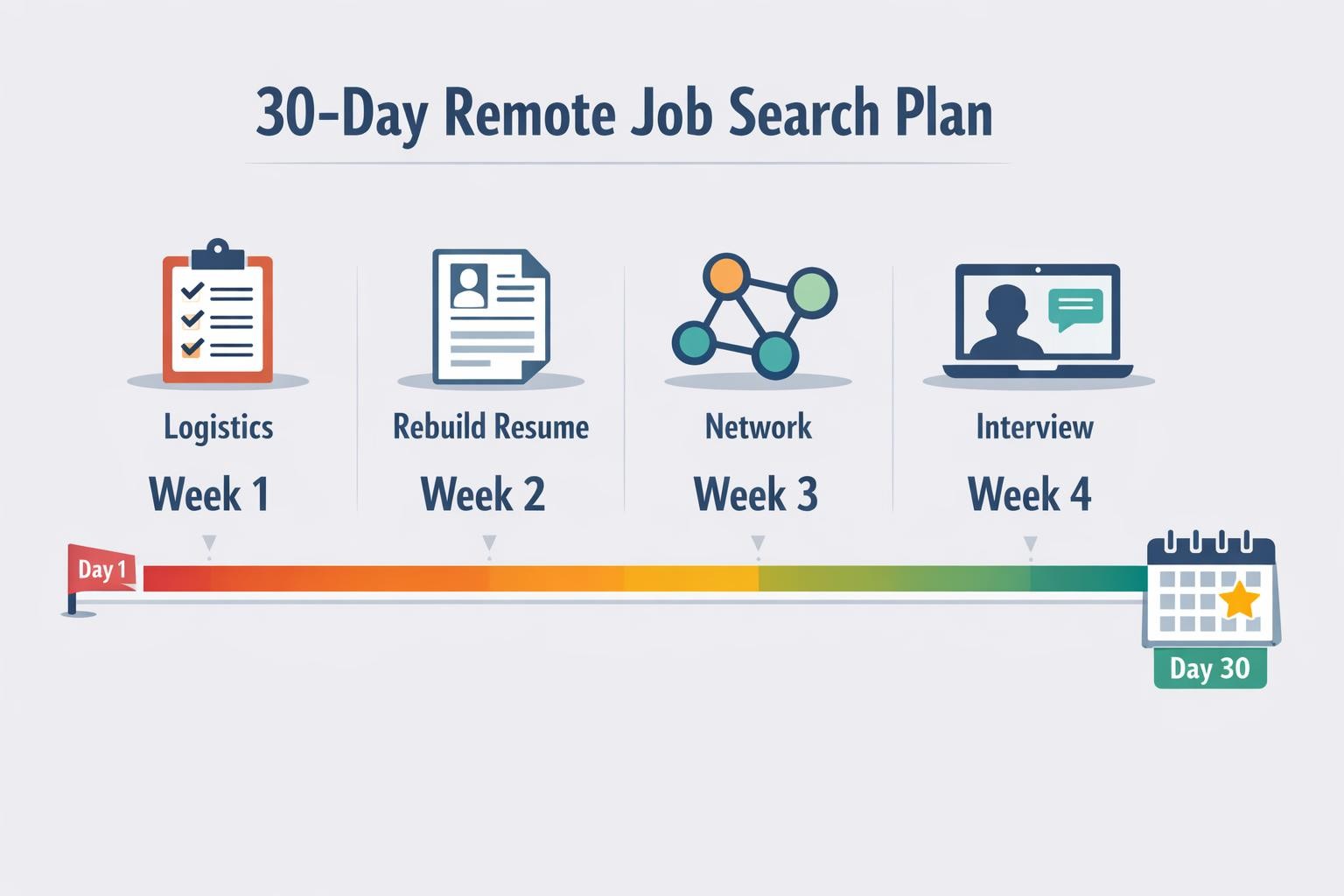
This article is your remote job search after a layoff plan. It is organized into four weeks because structure fights panic. Each week has clear objectives, specific tasks, and realistic timelines. By Day 30, you will have a rebuilt resume, an active pipeline of applications, and interviews on the calendar.
One stat before we start: U.S. job seekers in 2025 spend an average of five to six months finding a new role. But tech professionals with a focused strategy typically land in two to four months (ZipRecruiter/Careerminds). The difference is not luck. It is having a plan and working it daily.
Week 1 (Days 1-7): Handle Logistics and Reset
The first week is not about job applications. It is about securing your financial foundation and giving your brain permission to process what just happened.
Day 1-2: Immediate Logistics
Severance. Review your severance agreement carefully before signing anything. You typically have 21 days to sign (45 days if you are over 40, under the ADEA). Key things to check: Is the severance amount negotiable? Can you extend your health coverage beyond the COBRA window? Will the company provide a reference or outplacement services? If the agreement includes a non-compete clause, understand its scope and enforceability in your state.
Health insurance. COBRA lets you continue your employer's health plan for up to 18 months, but it is expensive because you pay the full premium plus a 2% admin fee. Compare COBRA costs against marketplace plans at healthcare.gov. In many cases, an ACA marketplace plan with subsidy is cheaper, especially if your income drops during the search.
Unemployment benefits. File immediately. There is often a one-week waiting period before benefits begin, so every day you delay is a day of lost coverage. The process is state-specific; search "[your state] unemployment insurance" for the direct application portal.
Budget. Calculate your burn rate: monthly expenses minus any severance, unemployment, or savings income. How many months can you search without financial pressure? This number determines how aggressive your strategy needs to be. If you have less than three months of runway, start applying in Week 1 alongside the logistics.
Day 3-5: Emotional Reset
A layoff is a grief event. You lost your routine, your identity (temporarily), your coworkers, and your income security in a single meeting. Treating it as "just business" and immediately grinding on applications leads to bitter, unfocused effort that comes through in interviews.
Take two to three days for yourself. Go for walks. Talk to people you trust. If you have access to an employee assistance program (EAP) from your former employer, use it. Many EAPs provide free therapy sessions that remain available for 30-60 days after separation.
When Marcus got laid off from his senior developer role, he spent three days cycling and talking to his partner before touching his resume. "The worst thing I could have done was apply to jobs while I was angry," he said. "I would have come across as desperate or resentful. Those three days cost me nothing and saved me from burning bridges."
Day 6-7: Secure References and Request Documentation
Before emotions fade and former colleagues scatter to new roles, contact two to three people who can serve as professional references. Your direct manager (if the relationship is good), a cross-functional collaborator, and a senior stakeholder are the ideal trio.
Also request: a written recommendation letter, confirmation of your title and dates of employment, and any performance reviews or positive feedback you received. These documents are harder to get six months later.
Week 2 (Days 8-14): Rebuild Your Professional Presence
Now the real work begins. This week is about retooling your resume, LinkedIn, and target list for a remote job search.
Resume Overhaul
Your existing resume is probably written for in-office roles. A remote-first resume needs specific adjustments.
- Add remote-specific skills. Mention tools like Slack, Zoom, Asana, Notion, Jira, or whatever platforms you used. Call out experience with asynchronous communication, distributed teams, and self-directed work. These are signals that tell remote employers you know how to work without someone watching.
- Quantify everything. "Managed a team" becomes "Managed a distributed team of 8 across 3 time zones, delivering 12 features per quarter." Numbers cut through resume noise.
- Remove location dependency. Delete any language that implies you need to be physically present. "Oversaw daily office operations" should become "Managed team operations and workflows."
- Add a summary line about remote readiness. "Remote-experienced [role] with [X years] of distributed team collaboration" at the top of your resume tells hiring managers exactly what they need to know in the first five seconds.
Read our full guide on how to write a remote job resume for a complete walkthrough.
LinkedIn Update
Update your LinkedIn before you start applying, because recruiters will check your profile within minutes of receiving your application.
- Headline: Change it to "[Your Role] | Open to Remote Opportunities" or "[Your Role] | Seeking Remote/Hybrid Roles." This makes you discoverable in recruiter searches.
- Open to Work badge: Turn it on. The data shows it increases recruiter outreach. Set it to "Recruiters only" if you prefer discretion, or "All LinkedIn members" if you want maximum visibility.
- About section: Write a short, specific summary of what you do, what you are looking for, and one or two key achievements. Skip the life story.
- Activity: Start posting. Share an article about your industry. Comment on three to five posts from people in your target companies. LinkedIn's algorithm rewards activity, and hiring managers notice engaged profiles.
For a full optimization guide, see our article on optimizing LinkedIn for remote jobs.
Build Your Target List
Do not spray applications randomly. Build a focused list of 30-50 companies that match your criteria.
- Filter by remote policy. Verify that the company is actually remote-friendly, not just "remote during COVID." Check their careers page for language like "distributed team," "remote-first," or "work from anywhere."
- Check recent layoff activity. Companies that recently laid off workers in other departments may still be hiring for your role. Check the best remote companies in 2026 for employers with strong remote cultures.
- Prioritize companies with open roles. Do not add aspirational companies with no current openings. Your target list should be actionable.
- Include company size variety. Mix startups (faster hiring, less bureaucracy), mid-size companies (more structured but still agile), and enterprises (longer process but stable). Do not put all your eggs in one basket.
Week 3 (Days 15-21): Active Applications and Networking Blitz
You have your resume. You have your list. Now it is time to execute at volume with precision.
Application Strategy
Apply to 8-12 targeted roles per week. Not 50 generic applications. Quality beats quantity in a remote job search because hiring managers can spot a mass-applied resume instantly.
For each application:
- Customize the first three bullet points of your resume to mirror the language in the job description. If they say "cross-functional collaboration," use that exact phrase.
- Write a specific cover letter paragraph (not a full page) explaining why you want this company and this role. Mention something specific: a recent product launch, a company value that resonates, a team member whose work you follow.
- Track everything. Use a spreadsheet or tool like Huntr, Notion, or Teal to log: company, role, date applied, contact person, status, follow-up date. Without tracking, you will lose opportunities in the noise.
- Use AI to accelerate your search. Tools like ChatGPT, Teal, and Jobscan can help you tailor resumes and prep for interviews faster. See our guide on AI tools for your remote job search for specific recommendations.
The Networking Blitz
Networking fills the pipeline that applications miss. Most remote roles are filled through referrals or direct outreach before they ever hit job boards.
- Reach out to 5 people per day. Former colleagues, industry contacts, people at your target companies. The message is simple: "Hi [Name], I was recently laid off from [Company] and am looking for remote [role type] opportunities. If you hear of anything or would be open to a quick chat, I would really appreciate it."
- Attend 2-3 virtual events per week. Industry webinars, remote work meetups, Slack community events. Show up, participate, follow up with people you connected with.
- Engage in online communities. Remote-specific Slack groups, Discord servers, Reddit communities (r/remotework, r/cscareerquestions), and industry-specific forums. Do not just post "I am looking." Add value first, then mention your search.
When Amira got laid off from a mid-size fintech company, she reached out to 87 people in three weeks. "Most did not reply," she admitted. "But four of them led to warm introductions to hiring managers. One of those introductions became my next job. The math is simple: more outreach equals more opportunities."
Free resource: Download our 30-Day Remote Job Search Action Plan -- the exact framework for the plan described in this article.
Week 4 (Days 22-30): Interviews and Negotiation
By week four, your early applications should be generating responses. Time to convert them into offers.
Interview Preparation
Remote interviews have their own dynamics. Preparation is both content and technical.
- Test your setup. Camera at eye level, lighting from the front, clean background, stable internet connection, headphones with a microphone. Test 30 minutes before every call. Technical problems in a remote interview send a terrible signal to remote employers.
- Prepare your stories. Use the STAR method (Situation, Task, Action, Result) for behavioral questions. Prepare five to seven stories that cover leadership, conflict resolution, failure, collaboration, and a major win. Rotate them across different interview questions.
- Research the company's remote culture. Are they async-first or meeting-heavy? Distributed globally or US-only? Knowing this lets you tailor your answers to show you understand their specific work style.
- Prepare smart questions. "How do you handle time zone differences?" "What does onboarding look like for remote hires?" "How do you measure success for this role?" These show you are thinking about the job, not just getting the job.
Read our full remote interview guide for a deep breakdown of video, phone, and async interview formats.
Salary Negotiation After a Layoff
Being laid off does not weaken your negotiating position. Companies are hiring for the role because they need someone. Your layoff is irrelevant to the value you bring.
- Do not disclose your previous salary. In many states, it is illegal for them to ask. If pressed, redirect: "I am focused on what this role pays based on the market and the responsibilities."
- Research salary ranges. Use DailyRemote salary data, Glassdoor, Levels.fyi, and Payscale to establish the market rate. Come to the negotiation with specific numbers, not vague expectations.
- Negotiate the full package. Remote work unlocks benefits worth thousands: home office stipend, internet reimbursement, co-working space allowance, flexible hours, extra PTO. If the base salary is firm, negotiate these.
- Do not accept the first offer out of fear. Layoff anxiety makes people jump at the first "yes." Take 48 hours to evaluate any offer. A bad fit that you accept out of desperation puts you right back in job-search mode in six months.
For a complete walkthrough, read our guide on negotiating a remote job salary.
Mental Health During Your Remote Job Search
Job searching after a layoff is emotionally brutal. The rejection, the silence, the uncertainty. Do not pretend you are fine.
- Maintain a routine. Wake up at the same time. Get dressed. "Start work" on your job search at a set hour. Structure creates a sense of control when everything feels uncontrollable.
- Set daily limits. Job searching for eight hours straight leads to diminishing returns and mounting anxiety. Four to five focused hours of applications, networking, and preparation is more effective than an exhausted full day.
- Track wins, not just outcomes. "Applied to 4 roles," "Had a great informational call," "Finished my LinkedIn overhaul" are all wins. Waiting to celebrate until you get an offer means weeks of feeling like you are failing.
- Move your body. This is not optional wellness advice. Exercise directly reduces cortisol (the stress hormone) and improves sleep, both of which measurably affect interview performance. A 30-minute walk before a big interview is worth more than another hour of prep.
- Talk to other people who have been laid off. Layoff support communities exist on Reddit, Discord, and LinkedIn. Hearing "I went through this and came out fine" from someone who actually did is more reassuring than any career advice article.
When Jake was laid off after six years as a product manager, he joined a weekly virtual job search accountability group with four other laid-off professionals. They reviewed each other's resumes, practiced interview answers, and kept each other honest about weekly targets. "Having people who understood the situation made the hardest weeks bearable," he said. "And one person in the group actually referred me to the company where I ended up getting hired."
Beyond Day 30: Continuing Your Remote Job Search After a Layoff
If you do not have an offer by Day 30, that is normal. The average search takes longer. But by now you should have:
- A fully optimized resume and LinkedIn profile
- A target list of 30-50 companies
- 40-60 applications submitted
- At least 5-10 meaningful networking conversations
- A few interviews in progress
If you are not hitting those numbers, audit your process. Is your resume getting past ATS filters? Are your target roles realistic for your experience level? Are you customizing applications or mass-applying? Adjust the inputs and the outputs will follow.
If your layoff has you rethinking your entire career direction, our guide on making a career change to remote work walks you through the full transition process. The 2026 job market is simultaneously experiencing layoffs and hiring. Companies are cutting roles in some departments while expanding in others, especially in AI, cybersecurity, cloud infrastructure, and data analytics. 55% of hiring managers expect layoffs in 2026 (Resume.org), but that same market has three times more remote jobs than it did in 2020. The roles exist. Your job is to find the ones that fit and present yourself as the clear choice.
You did not choose this. But you can choose what happens next. Start with Day 1.