
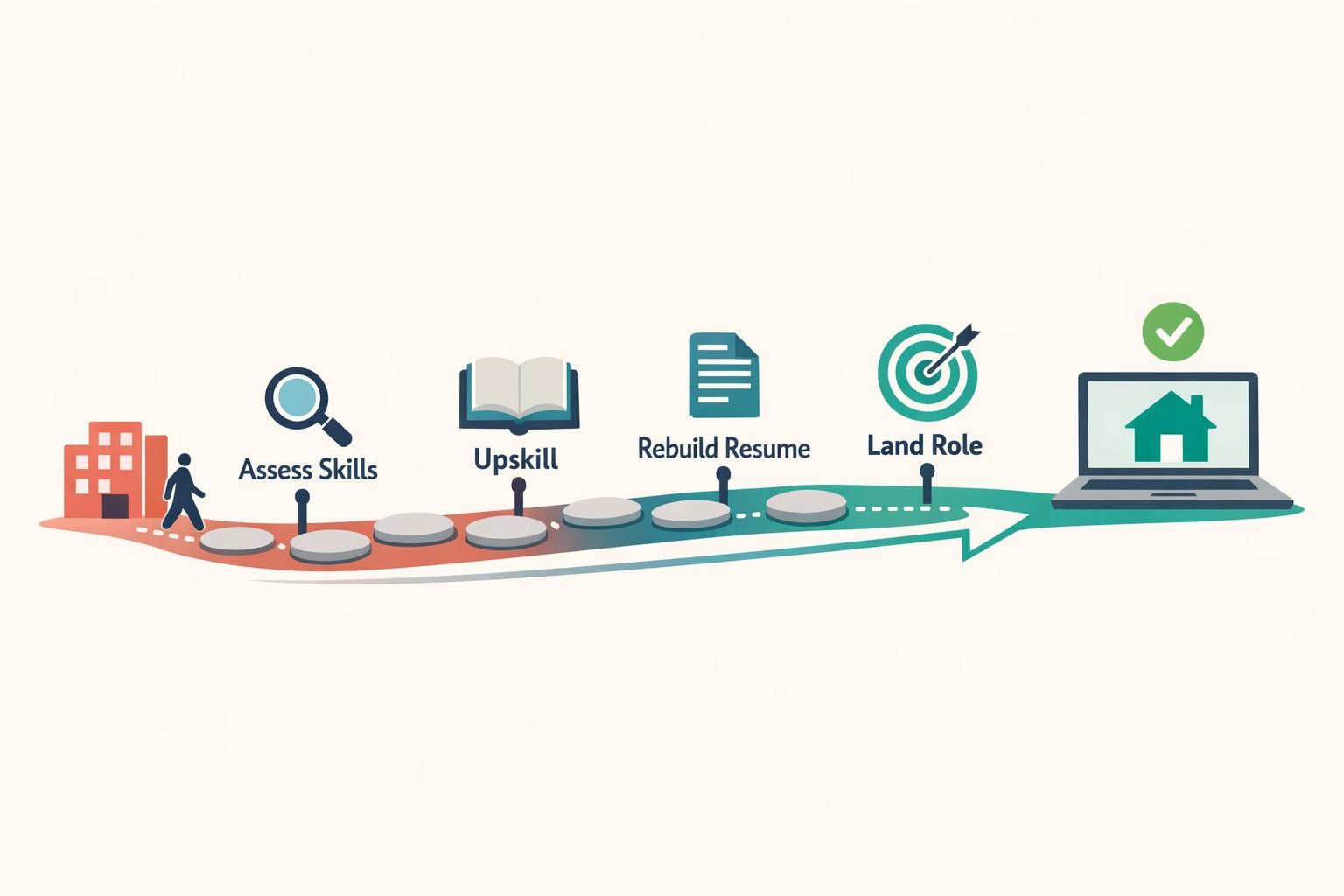
Sixty-nine percent of workers have switched or seriously considered switching career fields, and the number one reason is access to remote work (FlexJobs, 2025). The numbers point to a mass migration, not a passing trend. People are not just changing jobs. They are changing entire professional identities because they have realized that the career they built in-person can be rebuilt, often at higher pay, in a remote-first world. If you have been thinking about a career change to remote work, you are not alone, and the path is more concrete than you think.
This guide breaks the transition into specific, ordered steps. No vague motivational advice. Just the framework, timeline, and tactics that people actually use to move from one career into a remote role in a completely different field.
Signs It Is Time to Make a Career Change
Before you overhaul your career, make sure the problem is actually your career and not your current employer, your manager, or temporary burnout. A career change is expensive in time, money, and emotional energy. It should be the answer to a structural problem, not a reaction to a bad quarter.
You should consider a career change to remote work if:
- Your industry is shrinking. If your field has fewer jobs every year and the remaining roles are increasingly in-person, you are swimming against two currents at once. Pivot now while you have the financial stability to do it.
- Your skills are transferable but underused. You write well but spend your days in meetings. You manage complex projects but your company only promotes people who show up physically. The skills exist; the environment does not reward them.
- You have hit a ceiling that only location can fix. If the highest-paying roles in your field require relocation to a city you cannot or will not move to, remote work in a different field may offer a higher ceiling from your current location.
- Your body or family needs flexibility. Chronic health conditions, caregiving responsibilities, or a partner's relocation make commuting impractical. Remote work exists precisely to solve constraints like these.
When Natalie realized her 15-year career in retail management was never going to offer the schedule flexibility her family needed, she did not just look for "remote retail jobs" (there are almost none). She mapped her skills to a different field entirely. More on how she did that below.
Identifying Your Transferable Skills: A Framework
The biggest mistake career changers make is defining themselves by their job title instead of their skills. Your title is "Store Manager" or "Teacher" or "Account Executive." But your skills include project management, stakeholder communication, conflict resolution, data analysis, training, and process improvement. Those skills transfer directly into remote roles.
Here is a framework for extracting your transferable skills.
Step 1: List your daily tasks, not your job description. Write down everything you actually do in a week. "Coordinated schedules for 15 staff members" is a transferable skill (project coordination). "Managed a retail store" is a title that does not translate.
Step 2: Group tasks into skill categories. Common categories that map to remote work:
- Communication: writing, presenting, persuading, explaining complex topics simply
- Coordination: managing timelines, juggling multiple projects, keeping teams aligned
- Analysis: working with data, spotting patterns, making recommendations based on numbers
- Technology: using CRMs, spreadsheets, databases, or any digital tools daily
- People management: coaching, giving feedback, resolving conflicts, hiring
Step 3: Match skill clusters to remote job families. A teacher who communicates well, designs curricula, and manages classrooms maps cleanly to instructional design, corporate training, or content strategy. An account executive who manages client relationships, hits revenue targets, and uses CRMs maps to customer success, sales operations, or SaaS account management.
Step 4: Identify gaps. Compare your skill clusters against three to five job descriptions in your target field. What shows up in every posting that you do not have yet? That is your upskilling priority. For a deeper look at what employers value, read about the skills remote employers actually want.
Best Fields for a Career Change to Remote Work
Some fields absorb career changers better than others. The best ones value skills over specific credentials, have high demand for workers, and offer strong remote job availability.
Customer Success and Account Management
If you have worked directly with people in any capacity, you have the foundation. Customer success managers help existing clients get value from a product. The role rewards communication skills, empathy, and problem-solving. Many companies hire without requiring specific industry experience because they would rather train product knowledge than teach relationship skills.
Content Marketing and Copywriting
Every company needs written content: blog posts, email campaigns, social media, landing pages. If you can write clearly and learn basic SEO, this field is wide open. No degree required. A portfolio of 5-10 strong writing samples matters more than your resume. Browse remote marketing jobs to see current demand.
UX Research and Design
Teachers, social workers, and anyone who studies human behavior has a head start here. UX research is about understanding how people think and interact with products. A Google UX Design Certificate or similar program takes three to six months and qualifies you for entry-level roles. See remote design jobs.
Project and Product Management
If you have managed anything, people, budgets, events, store operations, you can manage projects. Get a PMP or Scrum certification, build familiarity with tools like Jira and Asana, and your management experience becomes directly relevant.
Data Analysis
Every industry generates data. If you are comfortable with spreadsheets, the jump to SQL, Tableau, or Python is shorter than you think. Data analysts are in high demand across every sector, and the work is inherently remote-friendly. Check the fastest-growing remote jobs in 2026 for where demand is strongest.
Tech Support and IT
Companies need people who can troubleshoot, communicate with non-technical users, and follow documentation. If you are the person friends and family call when their computer breaks, this could be your entry point into remote tech work.
Upskilling Strategies: Specific Courses and Certifications
The World Economic Forum projects that 39% of current job skills will be transformed or become outdated between 2025 and 2030. That sounds frightening, but it is actually good news for career changers. If everyone's skills are shifting, the gap between you and someone already in the field is smaller than it has ever been.
Here is where to invest your upskilling time.
- Google Career Certificates (Coursera): UX Design, Data Analytics, Project Management, IT Support, Digital Marketing. Each takes three to six months at 10 hours per week. Widely recognized by employers. Cost: around $49/month for Coursera Plus.
- HubSpot Academy (free): Content marketing, inbound marketing, email marketing, social media. These certifications are specifically valued in marketing and customer success roles.
- Scrum.org or PMI certifications: Professional Scrum Master (PSM I) or PMP for project management career changes. PSM I costs $200 and can be earned in a few weeks of study.
- freeCodeCamp or The Odin Project (free): For career changers targeting web development. Fully self-paced, project-based learning.
- Codecademy or DataCamp: SQL, Python, and data analysis courses. A few months of consistent practice gets you past entry-level job requirements.
The key is targeted learning, not collecting certificates. Pick the one or two skills that show up most frequently in your target job descriptions and focus there. Fifty percent of workers have already completed reskilling or upskilling (WEF, 2025), so you are not starting from behind. You are joining a movement.
Rewriting Your Resume for a Career Change to Remote Work
Your resume needs to do two things simultaneously: prove your new skills are real and show that your existing experience is relevant in a new context. Here is how to restructure it.
Lead with a skills summary, not a chronological work history. Your first section should list the skills that match your target role, with brief proof points. "Project Management: Led cross-functional teams of 12-15 people, delivered 20+ projects on deadline across 3 years" works whether you were managing retail store launches or software sprints.
Translate your past titles into transferable language. "Retail Store Manager" becomes "Operations Manager, [Company Name]." "High School English Teacher" becomes "Instructional Designer and Curriculum Developer." The new titles honestly describe what you actually did, just in language your target industry recognizes.
Add a "Relevant Projects" section. If you completed a Google certificate, did freelance work, or built a portfolio project, list it as a separate section above your work history. This proves you have current skills in your new field.
Include remote-specific signals. Mention experience with distributed collaboration tools (Slack, Zoom, Asana, Notion), self-directed work, and async communication. These are skills, not fluff. For a full guide, read how to write a remote job resume.
Free resource: Download our Six-Figure Resume Template -- reframe your experience for a completely new remote career.
Handling the "No Experience" Objection
Every career changer faces this moment: an interviewer asks, "You have never worked in this field before. Why should we hire you?" Here is the answer structure that works.
Acknowledge the gap directly. "You are right that I have not held this exact title before." Do not be defensive.
Bridge to your transferable skills. "But the core skills this role requires, client communication, data-driven decision-making, managing competing priorities, are exactly what I did for eight years in [previous field]. The context is different. The skills are identical."
Show evidence of commitment. "I completed [specific certification/course], built [portfolio piece], and spent three months studying [your industry]. I am not guessing that I want this. I have done the work to confirm it."
Frame your outsider perspective as a strength. "Career changers bring fresh thinking because we are not locked into 'this is how we have always done it.' I bring [specific perspective from previous field] that your team does not currently have."
Natalie, the former retail manager mentioned earlier, used exactly this framework to land a remote customer success role at a mid-size SaaS company. Read more remote career success stories for additional real-world examples of career changers who made the leap. She spent four months getting her HubSpot certifications, built a case study analyzing a real company's onboarding flow, and presented it in her interview. "They told me later that the case study is what clinched it," she said. "It proved I could do the job, not just talk about wanting to."
Financial Planning During Your Career Change
A career change to remote work often involves a temporary income dip. Plan for it.
- Build a runway. Three to six months of living expenses in savings before you start seriously transitioning. This gives you breathing room to turn down bad offers and wait for the right one.
- Start upskilling before you leave your current job. Evenings, weekends, lunch breaks. The goal is to have certifications and portfolio pieces ready before you need income from the new field.
- Consider a bridge role. A lower-paying remote job in your target field is worth more than a higher-paying role that keeps you stuck. The first remote role on your resume opens every door after it.
- Freelance to test the waters. Platforms like Upwork and Fiverr let you take small projects in your target field before committing to a full career switch. Even a few completed projects prove to future employers that you can deliver.
- Research salary ranges early. Use DailyRemote salary data to set realistic expectations for your target roles. Some career changes come with a pay increase; others involve a temporary step back with a clear growth trajectory.
If a layoff is accelerating your timeline, our remote job search after a layoff plan gives you a structured 30-day framework. Robert Half found that 38% of professionals are planning to look for new roles in early 2026, and 58% say their career expectations have changed significantly. The market is absorbing career changers at scale. You are not competing against a wall. You are joining a crowd.
Realistic Timeline for a Career Change to Remote Work
Realistic timelines prevent discouragement. Here is what most career changes to remote work look like.
Months 1-2: Research and decision. Identify your target field, map your transferable skills, and choose your upskilling path. Read our guide to finding remote jobs and our article on transitioning from office to remote work.
Months 2-5: Upskilling. Complete your primary certification or course. Build two to three portfolio pieces. Start networking in your target field through LinkedIn, virtual meetups, and industry Slack communities.
Months 4-6: Active job search. Apply to 10-15 targeted roles per week. Tailor every resume and cover letter. Attend virtual networking events. Reach out to people in your target roles for informational interviews.
Months 5-8: Interviews and offers. Most career changers land their first role in the new field within three to six months of active searching. The total timeline from "I want to change" to "I got the offer" is typically six to nine months.
This is not fast. But compare it to the alternative: spending the next five years in a field you have outgrown, commuting to a job that does not fit your life, watching remote-friendly industries grow without you. Nine months of focused effort is a small price.
Your First 90 Days After the Career Change
Landing the role is not the finish line. Your first 90 days set the trajectory for your entire remote career in the new field.
- Over-communicate. Career changers often go quiet because they are afraid of asking "dumb" questions. The opposite approach works better. Send daily updates your first month. Ask questions publicly in team channels. Show your learning process transparently.
- Find a mentor inside the company. Ask your manager, "Who on the team would you recommend I learn from?" Then schedule regular 1-on-1s with that person.
- Document everything you learn. Build a personal wiki of processes, terminology, and institutional knowledge. This accelerates your ramp-up and produces an artifact that helps future hires, which makes you look proactive.
- Deliver one visible win in your first 30 days. It does not need to be huge. A small process improvement, a well-received presentation, a solved customer problem. One tangible result erases the "no experience" concern faster than months of quiet competence.
The 170 million new jobs projected by 2030 (WEF) will go to people who can adapt. Making a career change to remote work is not a risk. Staying in a shrinking, inflexible field and hoping things improve is the real risk. Start mapping your transferable skills today.