
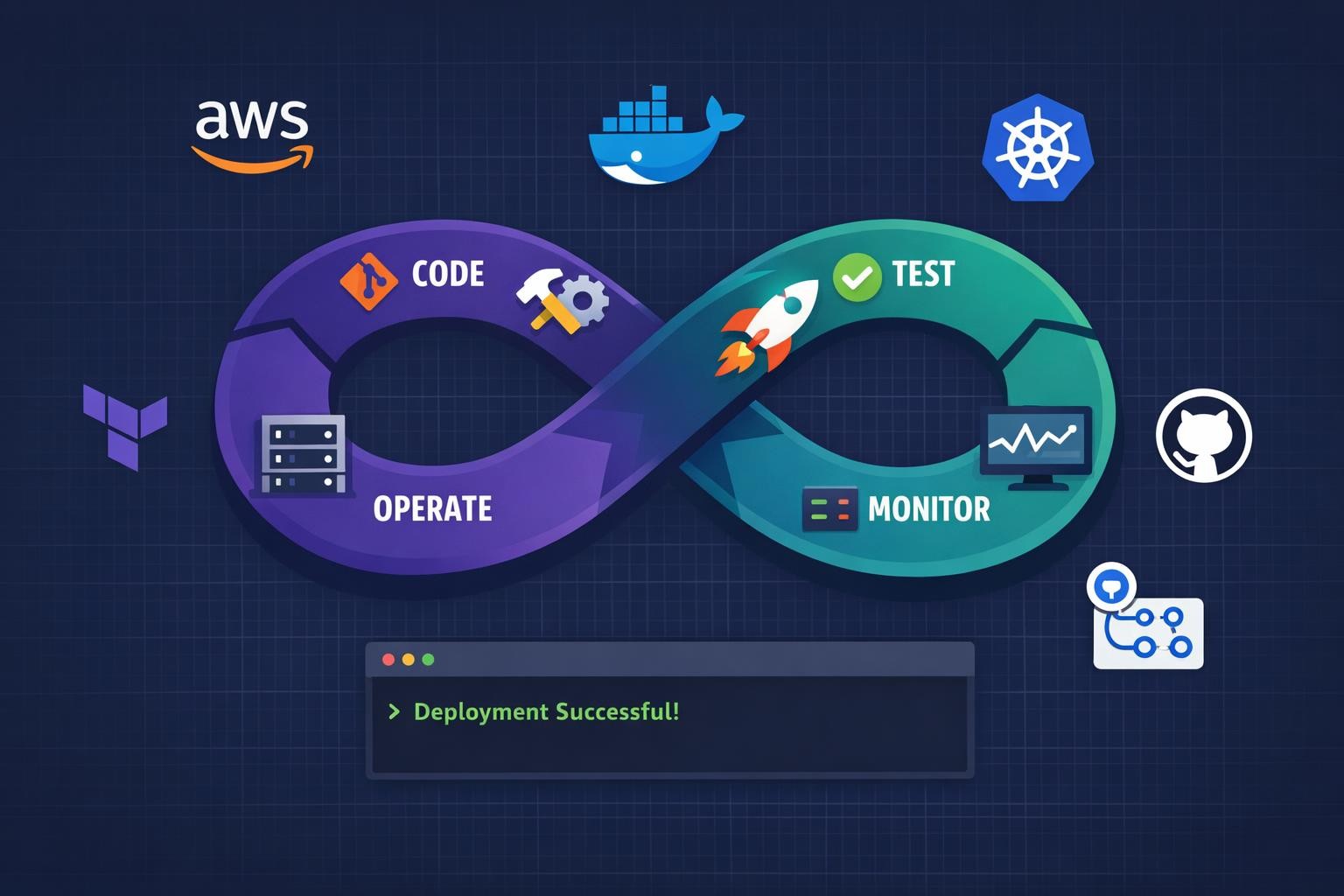
DevOps engineers were already working remotely before anyone called it "remote work." The infrastructure lives in AWS, GCP, or Azure. The pipelines run in GitHub Actions or Jenkins. The monitoring dashboards are accessible from anywhere with an internet connection. When companies went distributed, their DevOps engineers were the least disrupted people on the team because the tooling was already location-independent.
That has created strong demand for remote DevOps engineers. The bar is also high. Hiring managers expect candidates who can design, build, and maintain production infrastructure with minimal supervision, respond to incidents across time zones, and communicate system changes to engineering teams in writing. This guide covers the specific skills you need, where to find openings, how to build a compelling application, what salary to negotiate for, and how to prepare for every stage of the interview.
What Skills Do Remote DevOps Engineers Need?
Remote DevOps engineers sit at the intersection of software development and infrastructure operations. The role demands deep technical expertise paired with the communication discipline that distributed teams depend on.
Technical Skills Required
- Cloud Platforms: Production-level experience with at least one major cloud provider is non-negotiable. AWS dominates the market, but Azure and GCP are equally valid depending on your target companies. You need to understand compute (EC2, Lambda, ECS/Fargate), networking (VPCs, load balancers, Route 53), storage (S3, EBS, RDS), and IAM at a level where you can architect solutions and troubleshoot outages without reaching for documentation on common tasks.
- Infrastructure as Code: Terraform is the standard for multi-cloud provisioning. CloudFormation is essential for AWS-only shops. Pulumi is gaining traction among teams that prefer writing IaC in TypeScript or Python instead of HCL. You should be able to write, review, and refactor IaC modules that follow DRY principles and support multiple environments (dev, staging, production) without copying and pasting.
- Containerization and Orchestration: Docker for containerization and Kubernetes for orchestration are baseline requirements for mid-to-senior roles. You need to understand pod scheduling, service meshes (Istio, Linkerd), Helm charts, and how to debug container networking issues at 2 AM when the on-call page goes off. Experience with managed Kubernetes (EKS, GKE, AKS) is highly valued.
- CI/CD Pipeline Design: You should be able to design and maintain deployment pipelines using GitHub Actions, GitLab CI, Jenkins, CircleCI, or ArgoCD. Blue-green deployments, canary releases, feature flags, and rollback strategies are expected knowledge. The best DevOps engineers design pipelines that are self-documenting and require zero tribal knowledge to operate.
- Monitoring and Observability: Proficiency with Prometheus and Grafana for metrics, the ELK stack or Datadog for log aggregation, and OpenTelemetry or Jaeger for distributed tracing. You need to set up alerting that catches real problems without generating noise, and build dashboards that an on-call engineer in a different time zone can interpret without calling you.
- Scripting and Automation: Fluency in Bash and Python for automation scripts, glue code, and operational tooling. Many DevOps tasks involve writing custom scripts to bridge gaps between tools, automate runbooks, or process logs. Clean, well-documented scripts matter even more on remote teams where someone else maintains your code without a walkthrough.
- Security Fundamentals: Network security, secrets management (HashiCorp Vault, AWS Secrets Manager), SSL/TLS, vulnerability scanning, and compliance frameworks (SOC 2, HIPAA). The line between DevOps and security engineering keeps blurring, and candidates with security awareness command higher pay.
Essential Soft Skills
- Written Communication: You will document runbooks, write post-incident reports, author architecture decision records, and explain infrastructure changes in pull request descriptions. Your writing must be precise enough that an on-call engineer in a different time zone can follow your runbook at 3 AM without calling you. Precise writing is the foundation of effective remote operations.
- Incident Response Under Pressure: Production goes down. You need to diagnose, communicate, and resolve issues while coordinating with team members who may be waking up to the problem. Clear, calm communication in incident channels, concise status updates, and thorough post-mortems build trust with leadership and engineering teams.
- Cross-Team Collaboration: DevOps engineers work with software development teams, security, QA, and product management. You need to translate infrastructure constraints into language that application developers understand, and advocate for reliability investments without blocking feature delivery.
- Self-Directed Learning: The DevOps tooling world moves fast. New services, frameworks, and best practices emerge constantly. Engineers who proactively learn and share knowledge through internal documentation, tech talks, or proof-of-concept projects become the people their teams cannot afford to lose.
How To Find Remote DevOps Engineer Jobs?
Remote DevOps roles are abundant. The highest-quality positions go to candidates with targeted search strategies and strong professional networks.
Best Remote Job Platforms
- DailyRemote: Curated remote DevOps positions across industries with salary transparency. Also browse remote software development jobs and remote AWS jobs for overlapping roles.
- LinkedIn: Use the "Remote" location filter with titles like "DevOps Engineer," "Site Reliability Engineer," "Platform Engineer," or "Infrastructure Engineer." Set daily alerts to catch new postings early.
- Company Career Pages: Infrastructure-heavy remote-first companies like GitLab, HashiCorp, Datadog, Elastic, Cloudflare, Stripe, and Twilio often publish detailed job descriptions that include the exact tech stack you would work with.
- Wellfound: Good for startup DevOps roles where you own the entire infrastructure from day one. Broad technical exposure and direct impact on company reliability.
Building a Strong Profile
DevOps engineers demonstrate competence differently from application developers. You rarely have a traditional portfolio of visual projects. Instead, your profile should show systems thinking and operational maturity.
What to showcase:
- Open-source contributions: Contribute to infrastructure-related projects: Terraform modules, Helm charts, GitHub Actions, Ansible roles, or Kubernetes operators. Even well-documented issues and thoughtful code reviews demonstrate your expertise.
- Technical blog posts: Write about infrastructure challenges you have solved. "How We Cut Deploy Time from 45 Minutes to 8 Minutes" or "Designing Multi-Region Disaster Recovery on AWS" attract recruiter attention and show depth that a resume bullet cannot.
- Certifications: AWS Solutions Architect, AWS DevOps Engineer Professional, Certified Kubernetes Administrator (CKA), HashiCorp Terraform Associate, and Google Professional Cloud DevOps Engineer are all respected. They do not replace experience, but they validate knowledge and signal commitment.
- GitHub activity: Maintain public repositories with IaC modules, CI/CD templates, and automation scripts. Well-structured READMEs and consistent commit history show you write maintainable, production-quality infrastructure code.
Networking
- Join DevOps-focused communities: the DevOps subreddit, CNCF Slack, HashiCorp Discuss, and the DailyRemote LinkedIn group.
- Attend virtual conferences like KubeCon, HashiConf, and DevOpsDays. Follow up with speakers and attendees with specific technical questions, not generic connection requests.
- Contribute to internal and external knowledge sharing. Engineers who publish are engineers who get recruited.
How To Create a Resume and Cover Letter for a Remote DevOps Engineer Job?
Your resume needs to convey both technical depth and operational impact. Hiring managers want evidence that you can build and maintain reliable systems, not just that you know the tools.
Resume Tips
- Lead with infrastructure impact: "Designed auto-scaling architecture that handled 10x traffic spikes with zero downtime" beats "Managed AWS infrastructure." Every bullet should quantify reliability, performance, or efficiency improvements.
- List your tech stack clearly: Create a dedicated technical skills section organized by category: Cloud (AWS, GCP), IaC (Terraform, CloudFormation), Containers (Docker, Kubernetes), CI/CD (GitHub Actions, ArgoCD), Monitoring (Prometheus, Grafana, Datadog), Languages (Python, Bash, Go).
- Highlight remote experience: If you have been on-call in a distributed team, managed infrastructure across regions, or wrote runbooks for async operations, state it explicitly. These are strong remote-readiness signals.
- Include certifications: List cloud and DevOps certifications with the issuing organization and date earned. Place them prominently, especially if you have fewer years of experience.
- Two pages maximum: DevOps engineers often have broad experience across many tools and projects. Resist the temptation to list everything. Focus on the most relevant and impactful work.
Cover Letter
- Opening: Name the role and reference something specific about the company's infrastructure or engineering culture. If they have published blog posts about their tech stack, reference them. If they contribute to open-source infrastructure tools, mention your familiarity with those projects.
- Body: Describe one or two infrastructure achievements that align with the job requirements. Focus on business impact: uptime improvements, cost reductions, deployment velocity gains. "Reduced infrastructure costs by 35% through right-sizing and reserved instance optimization" tells a compelling story.
- Closing: Express interest and availability. Mentioning your comfort with on-call rotations across time zones is a relevant closing detail for DevOps roles.
Remote DevOps Engineer Salary
Remote DevOps engineers are among the highest-paid technical professionals. Infrastructure reliability is critical, the skill set is specialized, and the supply of qualified candidates has not kept up with demand.
Typical salary ranges by level (USD, annual):
| Specialization | Salary Range |
|---|---|
| Junior DevOps Engineer (0-2 years) | $80,000 - $110,000 |
| Mid-Level DevOps Engineer (2-5 years) | $110,000 - $150,000 |
| Senior DevOps Engineer (5+ years) | $150,000 - $190,000 |
| Site Reliability Engineer (SRE) | $130,000 - $195,000 |
| Platform Engineer | $125,000 - $175,000 |
| Cloud Architect | $155,000 - $210,000 |
| DevSecOps Engineer | $135,000 - $185,000 |
| Staff / Principal Infrastructure Engineer | $180,000 - $240,000 |
Multi-cloud expertise, Kubernetes at scale, security specialization, and experience with high-availability systems in regulated industries (fintech, healthcare, government) all push compensation higher. Equity and stock options at startups and growth-stage companies often add 15-30% to total compensation. For guidance on maximizing your offer, see the remote salary negotiation guide.
How To Prepare for a Remote DevOps Engineer Interview?
Expect three to five rounds: a recruiter screen, a technical phone screen, a system design or architecture session, a hands-on technical exercise, and a behavioral round focused on incident response and remote collaboration.
What a Typical Day Looks Like
A normal Wednesday as a remote DevOps engineer at a mid-size SaaS company: You check PagerDuty and Slack first thing. No incidents overnight, but there is a thread from a backend engineer asking why their staging deploy failed. You pull up the GitHub Actions logs, spot a flaky integration test, and open a PR to add retry logic. By 10 AM, you are working on a Terraform module to provision a new Redis cluster for the caching layer the backend team needs. You peer-review another engineer's Helm chart changes over lunch. At 1 PM, you join a 30-minute architecture review where you present your plan for migrating from self-managed Elasticsearch to a managed service, walking the team through cost projections and a rollback strategy on a shared Miro board. The afternoon is heads-down work: updating Grafana dashboards, writing a runbook for the new Redis cluster, and closing out a Jira ticket for a security audit finding. You are done by 6 PM.
Technical Interview Preparation
- System design questions: Expect to design deployment pipelines, monitoring architectures, disaster recovery strategies, or multi-region infrastructure. Practice articulating trade-offs between cost, complexity, and reliability. Draw architecture diagrams and explain your reasoning step by step.
- Hands-on exercises: Some companies provide a live challenge where you write Terraform, debug a Kubernetes deployment, or troubleshoot a CI/CD pipeline failure. Practice working in timed conditions with the tools you listed on your resume.
- Incident response scenarios: "Production is down. Walk me through your first 15 minutes." Interviewers want a systematic approach: verify the alert, check dashboards, identify the blast radius, communicate status, isolate the cause, remediate, and document.
- Security questions: Expect questions about secrets management, network segmentation, IAM policies, and compliance. Be ready to discuss how you secure CI/CD pipelines and container registries.
For broader software engineering interview preparation, review the adjacent guide which covers overlapping technical concepts.
Behavioral Interview Preparation
- Describe a major incident you managed: Walk through the timeline, your communication approach, the resolution, and the post-mortem. Emphasize what you changed to prevent recurrence.
- How do you balance reliability with feature velocity? Show that you understand the tension and have practical strategies: error budgets, SLOs, and progressive rollout strategies.
- How do you document infrastructure for a distributed team? Describe your approach to runbooks, architecture decision records, and onboarding documentation. Remote teams run on documentation quality.
- How do you handle on-call across time zones? Discuss rotation strategies, escalation policies, and how you maintain work-life balance while ensuring coverage.
Certifications That Strengthen Your Candidacy
- AWS Solutions Architect Professional or AWS DevOps Engineer Professional
- Certified Kubernetes Administrator (CKA) or Certified Kubernetes Application Developer (CKAD)
- HashiCorp Certified Terraform Associate
- Google Professional Cloud DevOps Engineer
- CompTIA Security+ (for roles with security overlap)
These certifications complement experience and differentiate you from candidates with similar backgrounds. For roles that overlap with security engineering, security-focused credentials carry extra weight.
Key Takeaways
- Cloud expertise is your foundation: Deep proficiency in at least one major cloud platform (AWS, GCP, or Azure) is the minimum requirement. Multi-cloud experience commands premium compensation.
- Infrastructure as Code is non-negotiable: Terraform, CloudFormation, or Pulumi fluency is expected for every mid-to-senior DevOps role. Maintain public repositories with well-structured IaC modules.
- Certifications validate and differentiate: AWS, Kubernetes, and Terraform certifications signal commitment, especially when transitioning from adjacent roles.
- Documentation is your remote superpower: Runbooks, architecture decision records, and post-incident reports build trust and operational resilience on distributed teams.
- Target specialized platforms: Use DailyRemote to find curated remote DevOps roles, and expand your search to AWS-specific and Kubernetes-specific listings.
- Prepare for incident scenarios: Interviewers will test your systematic approach to diagnosing, communicating, and resolving production issues under pressure.
- Quantify infrastructure impact: Every resume bullet and interview answer should include specific numbers: uptime percentages, cost reductions, deployment frequency improvements, or incident resolution times.