
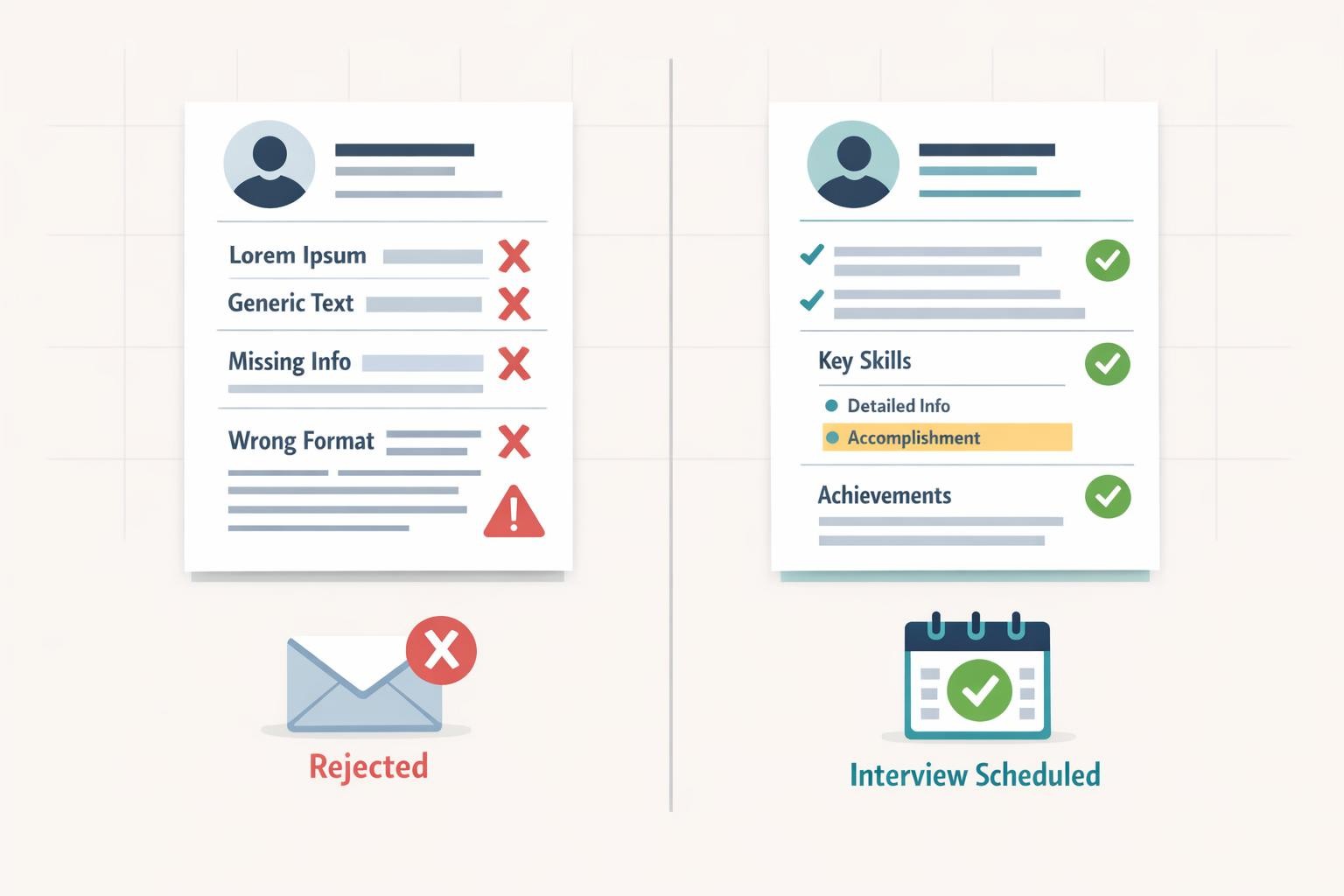
Remote job application mistakes are shockingly common, and they have a brutal cost. The average remote listing pulls 250+ applications, and most hiring managers spend fewer than 10 seconds on an initial screen. Small mistakes compound into a pattern of silence: no callbacks, no interviews, no offers. The frustrating part? The candidates making these mistakes are often genuinely qualified. They lose not because they lack skills, but because their applications fail to communicate those skills within the specific constraints of remote hiring.
After analyzing application patterns across thousands of remote postings and talking to hiring managers at distributed companies like GitLab, Zapier, and Buffer, the same 10 mistakes show up again and again. Some are obvious in hindsight. Others are counterintuitive. All of them are fixable.
1. Sending the Same Application to Every Job
This is the most common and most damaging mistake. Mass-applying with one generic resume and no cover letter feels productive. You can blast 20 applications in an hour. But it produces almost zero results because every single one is mediocre.
Remote roles attract applicants from around the world. A hiring manager reviewing 300 submissions can spot a generic application in seconds. The resume that does not mirror the posting's language. The cover letter (if one exists) that could apply to any company in any industry. The skills section listing everything you have ever touched rather than what this role actually needs.
What to do instead: Apply to fewer positions with higher quality. Spend 30-45 minutes per application. Customize your resume to match the specific role's requirements and terminology. Include a tailored cover letter that names the company and connects your experience to their actual challenges. Five carefully tailored applications will outperform 50 generic ones every single time.
2. Failing to Show Remote Work Readiness
Wanting to work remotely and being prepared to work remotely are different things. Many applications focus entirely on industry experience without addressing the employer's core concern: can this person work effectively without in-person supervision?
Remote hiring managers are evaluating a risk that does not exist for on-site roles. They are betting that someone they have never met, working from a location they have never seen, will be productive, communicative, and reliable without daily face-to-face interaction. Your application needs to de-risk that bet.
What to do instead: Address remote readiness head-on. If you have remote experience, put numbers to it: how many years, which tools (Slack, Notion, Asana, Loom, JIRA, Linear), how many time zones your team spanned, what results you delivered in that distributed context. If you do not have formal remote experience, highlight freelance work, open source contributions, remote volunteer projects, or any situation where you managed your own schedule and delivered results independently. Mention your home office setup. Name the collaboration tools you are proficient with.
3. Ignoring Time Zone Requirements in Remote Job Applications
Many remote postings specify time zone expectations: "Must be available during EST business hours," "Prefer candidates within GMT to GMT+3," or "Minimum 4 hours of overlap with Pacific time." Candidates routinely ignore these and apply anyway, hoping the employer will make an exception.
They usually will not. Time zone requirements exist because the team's communication cadence depends on overlap hours. A candidate who cannot meet this creates coordination problems that no amount of skill compensates for.
What to do instead: Read the time zone requirements and only apply if you can genuinely meet them. If the posting says "EST hours" and you are in a PST zone, that means starting at 6 AM. If you are willing and able to do that, say so explicitly in your application. If you are not, skip it and spend that time on roles that match your actual availability.
Browse remote jobs on DailyRemote and use the location filters to find positions that align with your time zone and geographic eligibility.
4. Writing a Resume That Reads Like a Job Description
Too many resumes list responsibilities rather than achievements. "Responsible for managing client accounts" and "Handled customer support tickets" tell the hiring manager what your job was, not how well you did it. For remote roles, this is especially damaging because the employer cannot observe your work ethic directly. They need your resume to prove your effectiveness.
What to do instead: Convert every bullet point from a responsibility to an achievement. Use the formula: [Action verb] + [specific task] + [measurable result].
Before: "Managed social media accounts for the company."
After: "Grew company Instagram from 8K to 45K followers in 14 months through data-driven content scheduling in Buffer, generating 300+ monthly inbound leads."
Before: "Responsible for customer onboarding."
After: "Redesigned customer onboarding workflow for a distributed SaaS team, reducing time-to-first-value from 14 days to 5 days and improving 90-day retention by 22%."
Numbers are the language of trust. Use them everywhere.
Free resource: Download our 6-Week Remote Job Search Plan, a structured framework that helps you avoid these mistakes and stay on track.
5. Neglecting Your Online Presence as a Remote Candidate
Remote hiring managers Google you. They check your LinkedIn. If your role involves anything public-facing, they look for your work online. A thin or outdated online presence creates doubt. And doubt kills applications.
This matters more for remote roles than on-site ones. An in-person interview can compensate for a weak online presence. A remote application cannot.
What to do instead: Before you start applying, audit yourself online:
- LinkedIn: Is your profile complete, keyword-optimized, and consistent with your resume? If not, follow our LinkedIn optimization guide for a full walkthrough.
- Google yourself: What shows up on the first page? If it is empty, publish a few professional articles, contribute to discussions in your field, or build a simple portfolio site.
- Social media: You do not need to sanitize everything, but make sure your public profiles do not contain content that would give a hiring manager pause.
- Portfolio: If you are in a creative, technical, or writing-heavy field, a portfolio with 3-5 strong examples carries more weight than 10 resume bullet points.
6. Applying to Jobs You Are Not Qualified For
The "apply anyway if you meet 60% of requirements" advice needs context. That advice was about on-site roles where cultural fit and local availability could compensate for skill gaps. Remote hiring is different. Employers receive so many applications from candidates who meet 90-100% of requirements that underqualified applications rarely survive the initial screen.
What to do instead: Focus on roles where you meet at least 80% of the stated requirements. For the remaining 20%, have a clear plan for bridging the gap. "I have not used Tableau, but I have built dashboards in Looker and Power BI, and I am finishing a Tableau certification this month" is credible. "I have never done data analysis but I am a fast learner" is not.
If you consistently find you do not meet requirements for the roles you want, that is a signal to invest in skill development first. Explore categories on DailyRemote to understand what skills are in demand for remote data science jobs, remote project management jobs, or whatever field you are targeting.
7. Skipping the Cover Letter
Many candidates treat cover letters as optional, especially when the application form does not explicitly require one. For remote positions, this is a strategic error. Your cover letter is the only chance to demonstrate written communication skills before the interview stage, and written communication is how remote work actually gets done.
A missing cover letter does not just fail to help. It actively hurts, because it signals one of two things: you do not care enough about this role to invest 20 minutes, or you do not have the writing skills to produce a letter.
What to do instead: Write a cover letter for every remote application, even when listed as optional. Keep it to 250-400 words. Address the specific company and role. Connect your experience to their needs. Show that you understand what working remotely at their company would actually look like. Use our cover letter templates as a starting framework, then customize each one.
8. Not Following Application Instructions
Remote job postings often include specific instructions designed to filter out inattentive candidates. "Include the word 'remote' in your subject line." "Submit your application as a PDF." "Tell us about a time you solved a problem independently." "Do not apply through LinkedIn; apply through our website."
Candidates who ignore these instructions self-select out of the process. Hiring managers use these filters on purpose. If you cannot follow simple application instructions, they assume you will not follow process documentation, workflow guidelines, or async communication protocols either.
What to do instead: Read the entire job posting before starting your application. Highlight specific instructions. Follow them exactly. If the posting asks you to answer specific questions, answer them directly rather than redirecting to your resume. If it specifies a file format, use that format. These details are easy to get right and immediately disqualifying to get wrong.
9. Having a Weak or Missing Remote Job Resume Summary
The top third of your resume is the highest-value space in your entire application. Many candidates waste it with a generic objective statement ("Seeking a challenging remote position where I can apply my skills") or skip it entirely and jump straight into work history.
For remote applications, this is a critical miss. The professional summary is where you establish your identity, quantify your impact, and signal remote competence in 3-4 sentences. It frames how the hiring manager reads everything else.
What to do instead: Write a summary specific enough that it could only describe you. Include years of experience, specialization, a headline achievement with a number, and a clear signal of remote capability.
Example: "Operations manager with 8 years of experience scaling distributed customer support teams for SaaS companies. Built and led a 35-person remote support organization across 4 countries, achieving 97% CSAT while reducing per-ticket cost by 28%. Expert in Zendesk, Intercom, and async team management through Notion and Loom."
This tells the hiring manager exactly who you are, what you deliver, and that you know how to do it remotely.
10. Giving Up on Your Remote Job Search Too Early
The most underrated mistake in remote job searching is quitting before the math has a chance to work. Remote searches take longer than on-site ones. Competition is global. The interview process for distributed roles is often more thorough, typically 4-6 rounds compared to 2-3 for on-site positions.
Many qualified candidates apply to 15-20 positions, hear nothing, conclude the market is impossible, and stop. But 15-20 applications, even well-crafted ones, is not a statistically meaningful sample. Most successful remote job seekers report applying to 50-100+ positions before landing an offer.
What to do instead: Set realistic expectations. Plan for a 2-4 month search if you have strong remote experience, and 4-6 months if you are transitioning into remote work for the first time. Track every application in a spreadsheet or Notion. Review results every two weeks and adjust based on the data.
If you are getting zero responses, the problem is likely your resume or application materials. If you are getting first-round interviews but not advancing, the problem is interview prep. If you are reaching final rounds but not receiving offers, look at salary expectations, culture fit, or competition from candidates with more remote-specific experience.
Each stage of the funnel requires a different fix. Identify where your applications stall and address that specific bottleneck.
The Compound Effect of Fixing These Mistakes
None of these mistakes exist alone. A generic resume leads to skipped cover letters, which leads to mass applications, which leads to zero responses, which leads to discouragement and quitting early. The cycle feeds itself.
The good news: fixing these mistakes also compounds. A tailored resume earns more reads. A thoughtful cover letter earns more interviews. Following instructions demonstrates the attention to detail remote employers value. Showing remote readiness de-risks the hiring decision. Each improvement amplifies the others.
Pick the mistake that sounds most like your current approach. Fix that one first. Then fix the next. Within two weeks, your applications will be unrecognizable compared to where you started.
Start with our complete guide to finding remote jobs, then browse current remote positions on DailyRemote to put these fixes into practice. Whether you are after remote writing jobs, remote engineering roles, or remote customer service positions, these principles hold across every category. The candidates who avoid these 10 mistakes do not just get more interviews. They get better interviews, at better companies, for better roles.